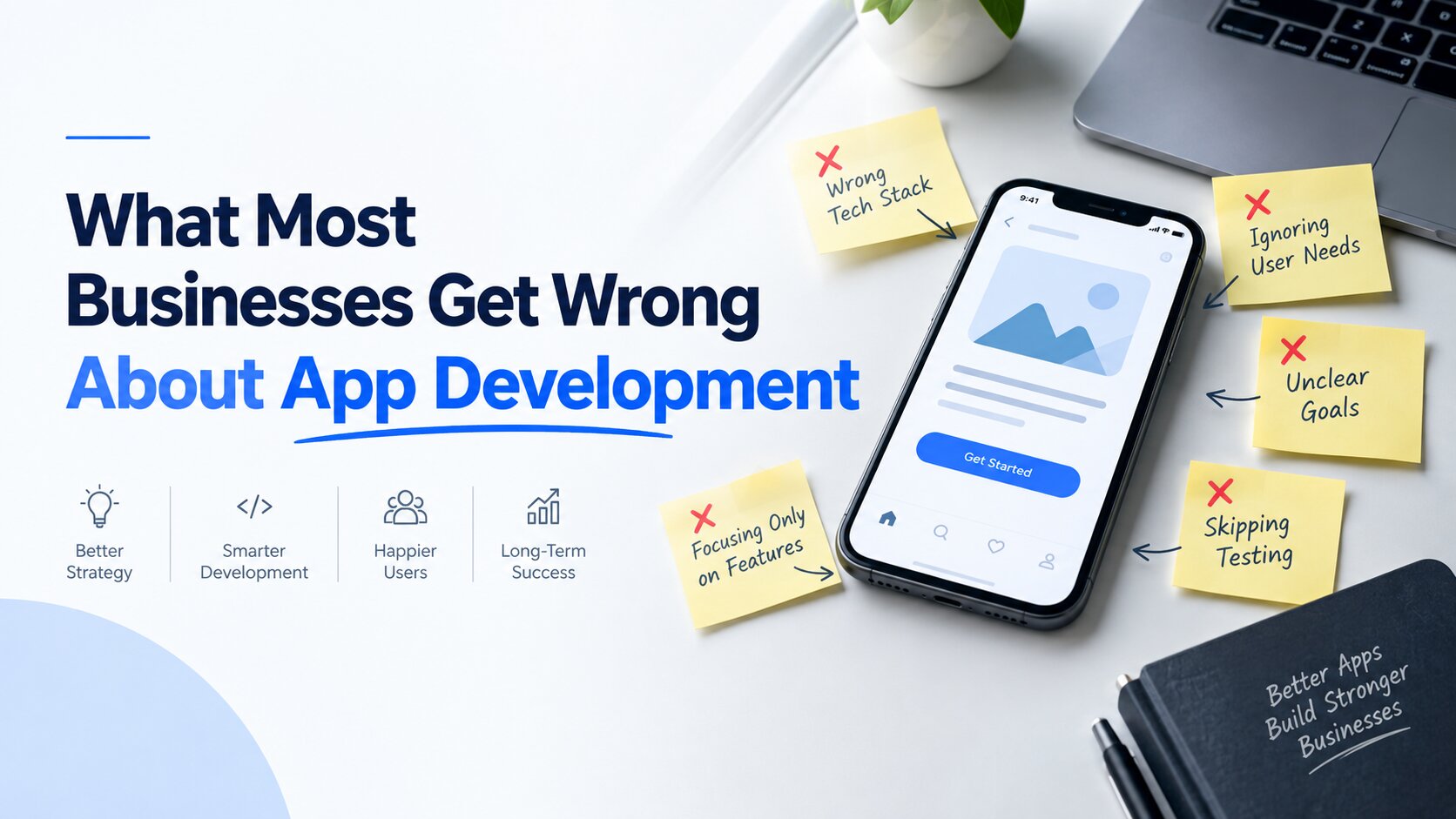
Here’s an uncomfortable truth: most app projects don’t collapse because a developer wrote sloppy code. They collapse before a single line of it gets written.

Industry research backs this up. The Standish Group’s long-running CHAOS Report has tracked software project outcomes for decades. The pattern barely shifts year over year: only around a third of projects hit their target on time, on budget, and to scope. The rest end up significantly compromised, or get scrapped entirely. Large-scale IT projects fare even worse. Success rates drop sharply as budgets and complexity grow.
If you’re a UK business owner, product lead, or decision-maker exploring custom app development UK-wide, that statistic should give you pause. Building an app isn’t impossible. But most businesses set themselves up to fail before they’ve even hired anyone.
This post breaks down the mistakes we see most often, and what to do instead.
Mistake 1: Treating App Development as a Purely Technical Project
The biggest misconception is thinking app development starts with developers. It doesn’t. It starts with a business problem.
Say a company briefs a development agency with “we need an app like [competitor],” instead of “we need to solve X problem for Y customer.” The team usually delivers a technically competent product. But nobody actually wants to use it.
What to do instead: Before writing a spec, define the specific problem the app solves, who it solves it for, and how you’ll know it’s working. If you can’t answer those three questions in a sentence each, you’re not ready to brief a developer yet — you’re ready to have a strategy conversation.
Mistake 2: Skipping Discovery and Jumping Straight to Design
Discovery is the research and planning phase where your team maps out requirements, user needs, and technical constraints. It’s the phase businesses most often try to cut, to save time and money. It’s also the phase that prevents the most expensive mistakes.
Skip discovery, and you typically find out mid-build that:
- The feature list doesn’t match what users actually need
- Integrations with existing systems (CRM, payment gateways, internal tools) are more complex than assumed
- The scope was never realistic for the budget or timeline in the first place
What to do instead: Treat discovery as a paid, standalone phase — even if it’s only one to two weeks. A good development partner should be able to hand you a clear scope document, technical architecture outline, and cost estimate at the end of it, before any development contract is signed.
Mistake 3: Choosing the Cheapest Quote Over the Right Partner
It’s tempting to compare app development agencies purely on day rate or fixed-price quote. But cost comparisons without context can mislead you. Two quotes for “the same app” rarely cover the same scope.
A lower quote often means:
- A smaller, less experienced team
- Vaguer scope, with “extras” billed later
- Offshore handoffs with limited communication overlap with UK working hours
- No allowance for QA, accessibility testing, or post-launch support
None of this means cheaper always means worse — but price without a clear scope comparison tells you almost nothing.
What to do instead: Ask every shortlisted agency for a like-for-like scope breakdown: what’s included, what’s explicitly excluded, who’s on the team, and what happens if requirements change mid-project. Compare value, not just the headline number.
Mistake 4: Having No Clear Definition of “Success”
This is one of the most common — and most fixable — mistakes. Businesses commission an app, launch it, and then have no consistent way to say whether it actually worked.
Studies on IT and digital projects consistently show one thing: setting measurable success criteria upfront dramatically improves outcomes. Teams that agree on quantified goals before work begins hit success far more often. Vague, after-the-fact judgement rarely works.
What to do instead: Before development starts, agree on 2–3 measurable outcomes: daily active users, conversion rate, support ticket reduction, time saved per task — whatever matters to your business case. Build these into the project brief, not just the marketing plan.
Mistake 5: Underestimating What Happens After Launch
Many businesses budget for build and stop there — forgetting that launch is the beginning of the app’s life, not the end of the project.
Post-launch reality typically includes:
- Operating system updates (iOS and Android release major versions annually, and apps need testing against them)
- Server, hosting, and API costs that scale with usage
- Bug fixes and security patches
- Ongoing feature development based on real user feedback
A common industry rule of thumb: budget 15–20% of the original build cost per year for maintenance and updates. Skip this planning, and your app often degrades quietly. Sometimes it breaks outright after an OS update, within 12 to 18 months.
What to do instead: Ask for a maintenance and support plan as part of the original proposal, not as an afterthought once the app is already live.
Mistake 6: Trying to Build Everything at Once
Ambition is good. Trying to launch with every feature you can imagine, on day one, usually isn’t.
The businesses that struggle most want a “complete” app before they’ve validated that anyone wants it in the first place. This drives up cost and delays launch. Worse, it means you make your biggest, most expensive decisions with the least amount of real user data.
What to do instead: Define a Minimum Viable Product (MVP) — the smallest version of the app that delivers real value and lets you test your core assumptions with actual users. Launch, gather feedback, then prioritise what to build next based on evidence rather than guesswork.
Mistake 7: Overlooking UK-Specific Compliance Requirements
This mistake catches out businesses working with international or offshore teams. Those teams aren’t always familiar with UK and EU-adjacent rules. Depending on your app, this can include:
- UK GDPR and Data Protection Act 2018 compliance for how user data is collected, stored, and processed
- Accessibility requirements (WCAG 2.2), particularly important for public sector or public-facing services
- PCI DSS standards if your app handles payments
- App Store and Google Play regional requirements, which can differ from US-first defaults
What to do instead: Confirm early whether your development partner has direct experience building for UK compliance frameworks — not just general data protection principles. This is a legal and reputational risk, not just a technical checkbox.
How to Actually Get Custom App Development Right
None of these mistakes are really about technology. They’re about process, clarity, and choosing the right partner over the fastest or cheapest one. In practice, this means:
- Start with the business problem, not the feature list
- Invest in proper discovery before committing to a build
- Compare agencies on scope and experience, not just price
- Agree on measurable success criteria before development starts
- Budget for the full lifecycle, not just the launch
- Build an MVP first, then iterate based on real feedback
- Confirm UK compliance experience upfront
Get these right, and you shift the odds significantly in your favour — turning app development from a gamble into a genuinely well-managed business investment.
Ready to Build an App That Actually Works for Your Business?
If you’re evaluating custom app development in the UK and want a partner who starts with discovery, not assumptions, get in touch for a no-obligation consultation. We’ll help you scope the right MVP, the right budget, and the right plan — before a single line of code gets written.
Frequently Asked Questions
Cost and timeline
1. How much does custom app development cost in the UK? Costs vary depending on complexity. A well-scoped MVP typically starts in the tens of thousands of pounds. Complex, multi-platform apps with custom backends cost considerably more. A discovery phase gives you an accurate estimate for your specific project.
2. How long does it take to build a custom app? An MVP typically takes 3–6 months from discovery to launch. This depends on scope, platform (iOS, Android, or both), and integration complexity. Larger, feature-rich apps can take 9–12 months or more.
Technical choices
3. Should I build a native app, or a cross-platform app? It depends on your goals. Native apps, built separately for iOS and Android, generally offer the best performance and device access. Cross-platform frameworks can reduce cost and speed up delivery for simpler apps. Your development partner should recommend a route based on your use case, not a default preference.
4. Do I need a mobile app, or would a web app work? Not every business needs a native mobile app. If your users mainly need occasional access without offline functionality or device features like camera and GPS, a responsive web app can be faster and cheaper to build and maintain.
5. What is an MVP, and why does it matter? An MVP (Minimum Viable Product) is the smallest version of your app that delivers real value to users. It matters because it cuts upfront cost and risk, and it lets you base later decisions on real usage data instead of guesswork.
Choosing a partner and planning ahead
6. How do I choose the right app development company in the UK? Look beyond price. Review their portfolio for relevant experience and ask for references. Confirm their approach to discovery and scoping. Check their track record with UK-specific compliance too, including GDPR, accessibility, and App Store regional rules.
7. What ongoing costs should I expect after my app launches? Beyond the initial build, budget for hosting and server costs, ongoing maintenance, OS compatibility updates, security patches, and new feature development. A common industry benchmark sets this at 15–20% of the original build cost per year.
8. Is GDPR compliance really necessary for a small business app? Yes. UK GDPR applies regardless of business size whenever you collect or process personal data. Non-compliance carries real legal and financial risk. Build it into your app’s farchitecture from the start, not as a fix after launch.it should be built into your app’s architecture from the start, not retrofitted after launch.